‘I wrote my own resignation letter twice in the first six months,’ Matt Wilson, Uber’s associate general counsel for Europe, the Middle East and Africa, says. ‘I didn’t hand it in either time, but it was close.’ Continue reading “Matt Wilson: Uber”
Pearson has elected to consolidate its legal adviser panels into new ‘general’ and ‘preferred’ rosters, moving away from specialised panels in a bid to reduce costs. Fourteen firms have won places on the preferred panel, which Pearson says will address ‘day-to-day requirements’, in addition to newer areas not historically covered by external counsel, including US immigration and US employment work. Among firms winning spots on the preferred panel were Charles Russell Speechlys, DWF, Freshfields Bruckhaus Deringer, Herbert Smith Freehills, Littler Mendelson and Morgan Lewis. Those appointed to the general panel were Bird & Bird, Cleary Gottlieb Steen & Hamilton, DLA Piper, Pinsent Masons and Sullivan & Cromwell. The review has been led by general counsel Bjarne Tellmann (below), who emphasised the need for chosen firms to have experience, as well as flexibility over billing. Continue reading “Significant matters”
The Polish have a somewhat colourful way of saying that something is not their problem – ‘not my circus, not my monkey’. Leaving private practice may well feel like you have escaped a zoo, but after a few days of taking over as in-house counsel it becomes increasingly clear that it is in fact your circus now and yes, you may well be that monkey! Continue reading “Workplace law: Doyle Clayton”
In April last year, US-based tech services provider DXC Technology was formed following the merger of The Hewlett-Packard Company’s enterprise division with Computer Sciences Corporation. It was the ideal opportunity for general counsel Bill Deckelman to sit down with senior management and establish what the legal function should look like.
‘To put things simply, it’s too hard for a GC to focus on the administrative side of things while also doing all the strategic stuff,’ says Deckelman. ‘Both the administrative and strategic pieces of the puzzle are becoming more complex and more labour-intensive, and GCs desperately need to think themselves out of the legacy models they have inherited, which were designed to serve completely different business and legal challenges.’
As one of the founding members of AdvanceLaw, a GC-only forum that allows members to share reviews and advice on law firm appointments, Deckelman was interested in taking a new approach to procurement. ‘I realised that the considerations you need to make when appointing counsel have become so complicated that it would be necessary to bring in a full-time person to run the tendering process. The big change in how we are working is that once a panel is selected we will interact with the firms throughout the year, giving them constant feedback on their performance and our expectations.’
A similar approach has been developed by Barclays, says Stéphanie Hamon, head of external engagement for legal. ‘Like any relationship, the client-law firm one can only work on trust and dialogue. You have to set out what you want and give feedback to make sure the other side understands if they are not delivering on it. We should treat our law firms as we do our employees. They’ve got a capability framework that they need to deliver against and to do that we need to give them regular feedback.’
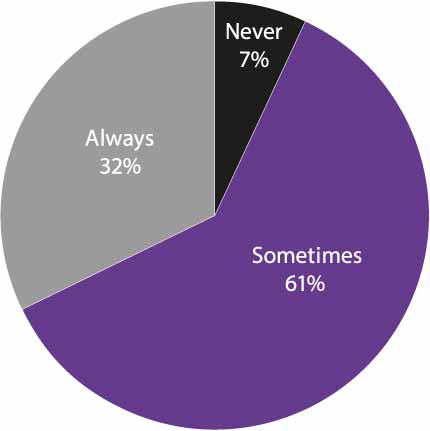
How often do you use alternative fee arrangements over hourly billing?
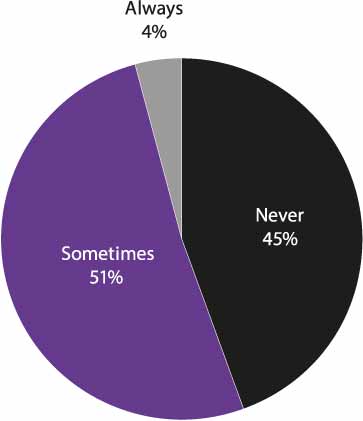
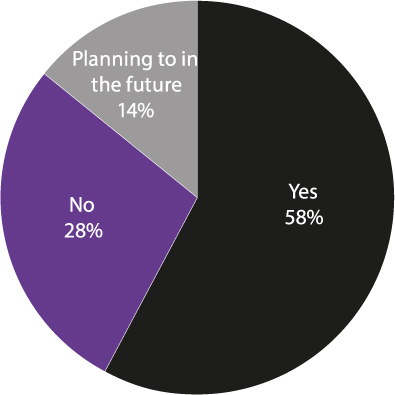
Do you use specialist pricing or procurement professionals in your legal team?
As a result, Barclays’ current panel review process will be its last. In its place, the bank will look to make a continuous assessment of its law firms.
While Barclays’ buying power is atypical, Hamon hopes the approach can be replicated by others. ‘The more we as a profession approach this in a standardised way, the more quickly the industry is likely to change.’ It is clear, however, that panels remain a popular means of assessing external firms.
Nearly two thirds (63%) of those surveyed had a formal panel in place, while a further 9% were planning to appoint one in the near future. It is also apparent that regular assessment of law firm performance remains a rarity. Nearly half (46%) of respondents said they evaluate outside counsel on an annual basis, while over a third (38%) evaluate performance only at the end of a particular matter. Just 14% said they conducted assessments every six months or more frequently.
“GCs desperately need to think themselves out of the models they have inherited, which were designed to serve different business and legal challenges. ” Bill Deckelman, DXC
Alongside the push for more frequent evaluation of law firms, larger and more sophisticated legal teams are increasingly willing to enter into a more mature conversation about how matters are priced. ‘I have seen a lot more GCs lately abandoning the demand that firms should be more efficient, which is really just a veneer for demanding deeper discounts,’ comments Casey Flaherty, founder of legal technology consultancy Procertas. ‘If that’s all you’re doing, then legal becomes a mindless procurement function. Strategic sourcing does have a role to play, but it can’t just be about beating people up on price. There are not many tricks in that particular bag. Ultimately, pushing down on costs will erode law firm relationships and also erode the value of the legal team.’
Hamon agrees: ‘Everyone is cost conscious, but getting the cheapest price is not a useful way to procure sophisticated services. We need our law firms to be profitable so they can hire the best lawyers. It’s not about squeezing their margins but working with them to address how they can deliver services in a way that covers gaps in our own offering and adds value to the business.’
National Grid’s Mo Ajaz says clients need to get their own affairs in order before criticising advisers. ‘Poor selling practices are prevalent, but we can’t just look at what the firms are doing and blame them without taking any responsibility for the poor buying behaviour that is equally prevalent among legal teams. Law firms are willing to change the way they work and to put effort into making things better, but we need to be clear about what we want. If you outline the steps you want a firm to take or state with clarity what you want to achieve, they will help you. What’s really interesting is that the firms themselves are now looking to build up their own legal ops offering and provide training to their clients on which parts of the legal process can be done by alternative providers.’
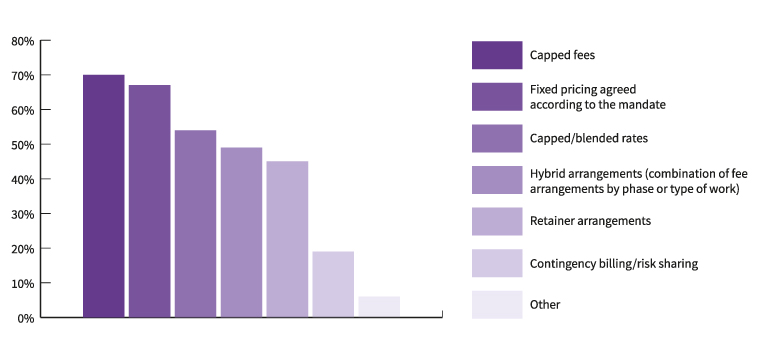
When using alternative fee arrangements, which models do you use?
Deckelman, who recently introduced a legal operations group run by finance professionals to DXC, has seen a similar change in the US. ‘Law firms are beginning to step up by bringing in their own internal budgeting people, often with a finance and accounting rather than a legal background. This trend has come a long way in the last year and will get stronger as law firms figure out that clients are not necessarily demanding lower costs but more rigorous methodologies when it comes to budgeting.’
“In the US, more lawyers are employed by commercial organisations than the 200 largest law firms.”
Casey Flaherty, Procertas
The trend toward measuring law firm performance will also help legal teams reflect on their own work, says Michael Shaw, GC of The Royal Bank of Scotland: ‘In-house lawyers do not normally speak the same language as our business colleagues. They do not necessarily appreciate what great work we do, because we have not been able to communicate that well. Having metrics and processes, driving efficiency, being able to show what we are doing to others has been a real sea change that has professionalised the function.’
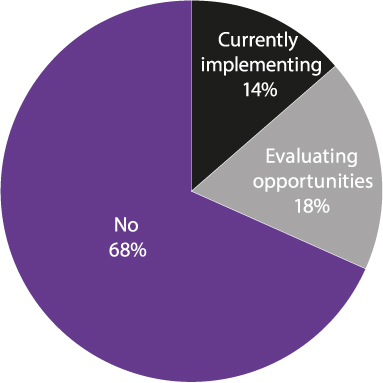
Are you currently or planning to conduct legal service delivery redesign projects?
Do you use alternative legal providers?
And, as Flaherty adds, it may be that the in-house wave is about to break. ‘The growth of in-house has been a prominent feature of the legal industry over the past decade or so, but it can’t continue. In the US, more lawyers are employed by commercial organisations than across the 200 largest law firms. We are now looking at huge payrolls for corporate legal teams and we need to ask whether there might be smarter ways of bending the cost curve.’
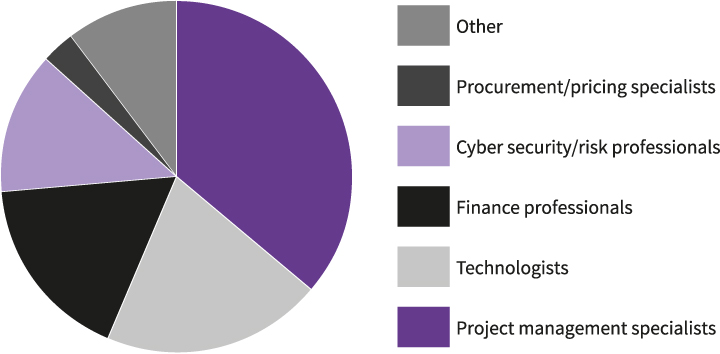
Which non-legal professionals would be most useful to your team?
Maurus Schreyvogel, chief legal innovation officer at Novartis, believes a symbiotic relationship between law firms, in-house teams and alternative providers will become the norm. ‘Even a company the size of Novartis will need law firms to control big events in M&A and litigation, because it is not cost efficient to have a lot of subject-matter expertise as regular members of the team. However, the same is likely to be true of the more commoditised legal work we handle. We have had good experience with alternative providers who use technology to resource legal work and I believe the market is finally mature enough for this to become the norm. That means the capability of law firms to deploy technology or work alongside outsourcers will become
the key decision criteria when we come to assess their ability to provide legal advice.’
Over the past few years in London, our disputes practice has seen a rising tide in big ticket claims against individual directors. We have also seen a similar trend across our global network and in some of the offshore jurisdictions where we have strong links with local firms. Continue reading “The rising tide of litigation against directors”
King Pyrrhus of Epirus famously said: ‘If we are victorious in one more battle with the Romans, we shall be utterly ruined.’ He was talking in 279 BC about the large number of soldiers he had lost in the battle of Asculum, but today he could just as easily have been referring to the high cost of litigation, or the pitfalls of winning the legal battle inside the courtroom at the expense of losing the communications war outside it.
Your client’s reputation may be more valuable than the matter you are litigating over, or at least the other side’s reputation may be. So winning in the court of public opinion is just as important, and sometimes even more so, than victory in the courtroom. But the courtroom and the outside world are connected for two important reasons. Firstly, because, as Lord Chief Justice Hewart said in 1924, in his appeal judgment in R v Sussex Justices, Ex parte McCarthy, it ‘is of fundamental importance that justice should not only be done, but should manifestly and undoubtedly be seen to be done’; and secondly because judges and jurors, no matter how impartial, urbane and sophisticated they may be, do not in reality sit in a vacuum, but ride the Clapham omnibus of popular culture to a greater or lesser extent, whether they like it or not.
In other words, there are two conversations going on: one inside the courtroom to persuade the judge, and the other outside the courtroom to persuade the public. The reality is that these two conversations are linked. Not only to the extent that they make the same arguments in different ways, but also because one cannot help but inform the other.
This means that you need to develop your PR strategy alongside your legal strategy, from the outset. In the most extreme circumstances, your PR strategy might dictate that you should not litigate, no matter how good your case, because of the balance between the possible legal gain and the certain reputational risks involved for your client. At the other end of the scale, your PR strategy might dictate that you bring a particular case, in a particular jurisdiction, which you might not otherwise have brought, because of how that case will play in your overall strategy, and how that will set up both the legal and public narrative for other current and future cases. Or there will be times when you consider a legal case to be too weak, complex, costly, slow or unrewarding for your client, but where the reputational concerns of the other side mean that a carefully orchestrated settlement PR campaign, threatening to litigate, can bring the other side to make a settlement offer to your client. And when it comes to group actions, it is often not possible to bring or manage the legal claim at all without a strong litigation PR campaign recruiting and keeping informed the corporates or consumers involved.
This asymmetric approach to litigation and PR is particularly key in complex, cross-border international commercial litigation, but its deployment in any case can often mean the difference between success and failure for your client, both inside and outside the courtroom.
“Speed is key. A pithy comment on a judgment will often go far if it is given within minutes of the judgment being handed down.” Tim Maltin, Maltin PR
When to comment and what to say
As Sun Tzu said in The Art of War: ‘Attack is the secret of defence; defence is the planning of an attack.’ The decision whether to be reactive or proactive in your litigation PR strategy is to a great extent a false one in practice. For example, you may decide to keep quiet unless the other side goes on the PR offensive. But all good journalists seek balance in their stories, and in particular like to get the view of the other side of a case, as well as encouraging rebuttal comments from those who will be criticised, so you will get an early warning of the impending attack when you or your client are asked to comment. Then you can deploy the full force of your carefully prepared reactive PR strategy, preemptively turning the fire of the attack back on your opponent, either killing their article or shaping it to your own messaging.
Sometimes no comment at all really is the best comment, but usually only when you are either losing hard or winning big. But these can also be the best times to get on the front foot, by getting to the real or metaphorical microphone first and shaping the news agenda to fit your narrative.
Contrary to popular belief, there is wide latitude to comment on active public court cases. The strict liability rule in s1 of the Contempt of Court Act 1981 ‘applies only to a publication which creates a substantial risk that the course of justice in the proceedings in question will be seriously impeded or prejudiced’, and ‘only if the proceedings in question are active at the time of the publication’. And ‘a person is not guilty of contempt of court under the strict liability rule in respect of a fair and accurate report of legal proceedings held in public, published contemporaneously and in good faith’. Furthermore, ‘a publication made as or as part of a discussion in good faith of public affairs or other matters of general public interest is not to be treated as a contempt of court under the strict liability rule if the risk of impediment or prejudice to particular legal proceedings is merely incidental to the discussion.’
As with so many things in today’s world, speed is key. A pithy comment on a judgment will often go far and wide if it is given within minutes of the judgment being handed down. An hour’s delay and the other side will have beaten you to it, or the story will have been written, or in high-profile cases social media may have already gone off-message. Get out ahead and stay ahead in the mainstream media, and monitor it and social media closely, correcting misinformation where the readership and influence of any publication requires it.
The importance of integration
With the high stakes of litigation, it is vital that a bond of trust is developed between the legal team and the litigation PR team. Often pure legal advice is at odds with pure PR advice, so to optimise the outcome for clients, litigators increasingly need a good feel for the balance between the priorities of the law and reputation management, just as specialist litigation PR experts must understand the legal reporting restrictions, the fine details of the case, and the client’s wider objectives. The client, legal and PR teams need to work very closely with each other, both at the planning and execution stages. Thorough planning and preparation is key, including preparing quote books in advance, as your plan will sometimes need to be executed in the heat of battle, where speed and precision are vital in order to take and keep control of the narrative.
Only by PR and legal working hand in hand will you win both the legal battle and the reputation war. And the reality is that winning the reputation war will help you win the legal battle.
Tim Maltin is the chief executive of Maltin PR, a London-based communications agency specialising in corporate, legal and litigation PR and reputation management.
Technology is at the heart of the legal sector’s current, well-publicised drive for innovation. With the demands placed on in-house legal teams increasing, and legal budgets trending downwards, the pressure on outside counsel to provide genuine value to their corporate clients has never been greater. Continue reading “Revolutionising dispute resolution”
Leading a global legal team is a complex role and many general counsel could be forgiven for spending all their energy just trying to get the job done. Not so at Michelin. Despite overseeing a legal community of 200 members, comprising lawyers, patent engineers, paralegals and admin staff, spread across 20 countries, group GC Benoit Balmary wanted the team to develop a defined strategy of its own alongside supporting Michelin’s goals. Continue reading “Going places”
The increasing popularity of online shopping has resulted in a decline of footfall on the high street and rising business rates, wages and pension costs have resulted in a tough trading environment. With well-known retailers such as Toys R Us, Prezzo, Carpetright, New Look, Mothercare, House of Fraser and recently Homebase all announcing restructuring plans, there is uncertainty surrounding the future of the high street retail sector. Ashfords discusses what options are open to struggling retail businesses.
2018 has seen a rise in company voluntary arrangements (CVAs) and administrations, following a significant decline in the retail performance over the last couple of years.
British Retail Consortium has reported a fall of 8.6% in footfall on the high street in 2017. Generally, retail businesses favour CVAs over entering administration, this tends to be for a number of reasons that include:
it is a fairly cheap out of court process;
the directors retain control of the company;
employees and management are more likely to keep their jobs;
suppliers are more likely to get paid;
shareholders prefer them as the legal entity itself survives.
But are CVAs really the best approach for the retail sector? The recent House of Fraser issues have highlighted some of the negative impact on the wider retail sector. House of Fraser had a CVA approved in June this year which involved the closure of 31 of its 59 stores across the UK and Ireland. Under the arrangement, stores scheduled for closure would remain open until early in 2019.
For retail businesses, there is growing pressure to adapt to a changing climate. It is always advisable to seek advice at the earliest opportunity.
A group of House of Fraser’s landlords filed a legal challenge against the CVA in the Scottish courts, claiming that they were ‘unfairly prejudiced’. The legal challenge brought by the landlords highlights the problems with the increasing use of CVAs amongst retail businesses, with landlords often being left significantly out of pocket. The House of Fraser landlord’s representatives said ‘CVAs were designed as a means to rescue a business, not simply a tool to shed undesirable leases for the benefit of equity shareholders… applying a 75 per cent arbitrary discount to the value of landlords’ claims is not the market norm and has no basis in law’.
High street retail businesses are often tied into lengthy leases, frequently with upwards-only rent reviews. The CVAs proposed by high street retailers tend to suggest a reduced rent for occupying the premises and may also include deferring rent payment dates or amending covenants. CVAs require at least 75% of those creditors who vote, voting by value, to agree to the CVA in order for it to be approved and implemented. Landlords can only vote on the CVA proposal based upon one year’s rent and if the CVA is approved, it will bind all creditors, including landlords, regardless of whether they voted in favour or against the CVA or simply abstaining. If the CVA is rejected the business will inevitably fail leaving the landlord with empty premises and no rental income. In the current climate, finding a replacement tenant can be difficult and the landlord may have to pay business rates in the meantime.
With this in mind would administration be preferable? Notable companies which have gone into administration this year include Toys R Us, Maplin, House of Fraser and Poundworld. Administrations are often paired with a pre pack sale of the business, where either the shareholders or a third-party purchase the profitable parts of the business, leaving the liabilities behind. The sale takes place immediately after the appointment of the administrators on pre negotiated terms. In the case of House of Fraser, the purchase of the business by Sport Direct took place less than three hours after the administration was announced.
Pre pack sales are often seen as a controversial rescue regime. Creditors have little say, if any, and are often not aware of the administration until days after the sale has concluded. With the sale of the business often being back to the existing management, it is commonly viewed as a way for businesses to write off debts and simply start again with a clean slate. As well as leaving supplier debts behind, employees’ pension schemes are often not taken on by the purchasing entity, leaving the pension schemes to be picked up by the pension protection funds which often results in significant reductions to pension payments.
However, pre pack sales can have some advantages:
the business can continue trading as a going concern;
employees will transfer over to the new entity; and
the process can be effected very quickly, minimising the duration of disruption.
Given the controversial nature of pre pack administrations, especially back to the same management, in 2015 the government introduced a pre pack pool online portal. The intention was that pre pack proposals could be reviewed by independent assessors who would determine whether the proposals were reasonable or not. The pool was not compulsory and there was a fee to use it, which ultimately resulted in a lack of use of the portal.
With the increase in high-profile retail administrations and pre pack sales, the government is facing increasing pressure to address concerns over the abuse of pre pack sales, particularly where the sale of the business is back to the same management.
Last week, the government announced plans to scrutinise pre pack sales far more closely and potentially disqualify or impose fines on directors who leave behind their employee pension, payroll and creditor obligations as part of pre pack administration sales, commonly referred to as ‘phoenix’ entities. The plans are to be set out in further detail in Autumn 2018 as part of the government’s response to a consultation on corporate governance and insolvency.
Conclusion
For retail businesses, there is growing pressure to adapt to a changing climate. Although there are insolvency and rescue options available, it is always advisable to seek advice at the earliest opportunity to minimise the risk of becoming the next retailer, landlord or supplier to fall victim to an insolvency process.
Ashfords is a leading national provider of legal, professional and regulatory services. We combine legal expertise, commercial experience and our wider network to help our clients achieve their goals, providing value for time and value for money. Our experts possess specific industry knowledge which can help in-house lawyers in the retail sector.
‘A good general counsel should do three things,’ says National Grid’s Alison Kay: ‘Manage the legal requirements of the business, manage their people and manage their budget.’ But as managing the legal requirements of a large business becomes more time consuming, GCs are increasingly finding it difficult to pay adequate attention to costs and staff. Continue reading “Hired help”
‘There’s a palpable sense of innovation in the legal industry,’ says Casey Flaherty, founder of legal technology consultancy Procertas. ‘But then,’ he adds, ‘there always has been.’ Continue reading “The innovation illusion”
For general counsel struggling to manage the administrative and regulatory burdens of the role, a head of operations has become the must-have accessory. In the US, the growth of legal ops is demonstrated by statistics. Continue reading “Journey into the unknown”